


Psoriasis is an inflammatory skin disease.Occurs when there is a malfunction in the immune system.The development of the disease is divided into clear stages - appearance, progression, stabilization and regression.The different stages of psoriasis differ in the appearance of the spots and rashes, the severity of the itching, and the extent of skin inflammation.
Why is it necessary to distinguish between the stages of development of the disease, and what are the features of the course of psoriasis at the beginning of development and during the recovery process?
Why do you need to know the stages of psoriasis?
The division of psoriasis into stages is used by doctors to correctly select therapeutic methods.The complex of medications and external agents that are prescribed to treat inflammation depends on the stage of development of the disease.
At the onset of the disease, general therapy is necessary - vitamin complexes, diet, external aseptic treatment of the rash, for example, a course of UV treatments.They also prescribe medications that stimulate cleansing of the intestines, blood vessels, and liver.
The psycho-emotional state must be corrected by a neurologist or psychologist.
At the initial stage of the disease, do not use potent drugs that suppress the immune system, and do not prescribe hormonal ointments.These drugs have a large list of side effects, so they are prescribed only when it is impossible to do without them.
Psoriasis: treatment in the acute stage and in remission
In the acute progressive course of the disease, several drugs with different effects are prescribed.Immunosuppressants and glucocorticosteroids are often used to relieve inflammation and reduce itching.External treatment is supplemented with photochemical, ultrasound and laser therapy.Antiseptic treatments for damaged skin are also prescribed.
In a stabilized state, they continue to take anti-inflammatory hormonal drugs, gradually reducing their dose.To restore damaged skin, ointments with a regenerating effect are prescribed.
In the remission stage - they support the body.Correct nutrition, take complexes of vitamins and minerals to restore immunity.
Timeliness of treatment
The earlier treatment is started, the easier it is to get psoriasis under control.
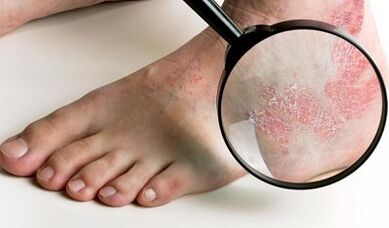
Timely therapy limits the spread of skin inflammation, reduces its extent, and prevents subsequent relapses of peeling.Since in the early stages psoriasis is often mistaken for an allergic rash, it is necessary to know its initial signs so as not to miss the appearance of a skin disease.
Note:Doctors are still figuring out the causes of psoriasis.But it is definitely known that psoriatic inflammation of the skin is not contagious.It cannot be caught from a sick person, or caused by an infection through injury.This is one’s own, personal failure in the human body.
The cause of psoriasis is an immune failure, which can be caused by various factors.Severe stress, poisoning (including potent medications, industrial emissions, alcohol), previous infection.
Treating psoriasis is difficult.The disease is prone to returns and relapses.And the therapy itself is symptomatic.It consists of preventing the appearance of new spots and relieving existing skin itching.
What stage of psoriasis is called the initial stage?How to distinguish psoriasis at the beginning from a diathesis rash?And how will the disease develop in the future?
Psoriasis: initial stage
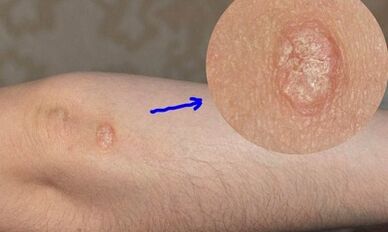
The first appearances of psoriasis on the skin look like pimples.Most often, the rash appears on the bends of the elbows and knees, or in places where clothing is pressed tightly to the body (for example, under a belt at the waist).Rashes may also appear along the edges of the hair and under the hair, around the nails and on the nail beds.Sometimes psoriasis occurs on the feet and palms.
Psoriasis almost always manifests itself symmetrically - on the elbows of both arms, or on both sides of the lower back, or on two knees.
The pimples themselves (in medical terminology - papules) in the initial stage have a modest appearance.They have:
- Pink or red color;
- Clear, unblurred edge;
- Small size - the pimple at the base does not exceed two millimeters;
- Flat shape - small pinpoint pimples at the beginning of the disease have almost no convexity, so they look like spots.
As the disease progresses, flakes of peeling skin appear on the pimples.They are gray or silver, and appear white against the background of the red pimple.
The appearance of scales is accompanied by quite severe itching.If you can't resist scratching, the scales come off, revealing shiny areas of pink, young skin underneath.It is very thin, vulnerable, and if you scratch the itchy papules for a long time, it becomes injured and bleeds.
The duration of the initial stage of psoriasis is up to four weeks.
Psoriasis: progression stage

In the progressive stage, individual pimples merge into one common spot, forming so-called psoriatic plaques.They are raised above the surface of the skin and are almost completely covered with peeling.Along the edges of psoriatic plaques there is a non-flaky pink-red rim.
The presence of a rim is a sign of a progressive stage of the disease.The width of the rim is one to two millimeters.The skin on it is inflamed and its structure resembles parchment paper.
The rim represents the area where the spot expands.This is the skin that is already inflamed, but does not peel off yet.After some time it will also become covered with scales.And the spot will expand, capturing new areas of the skin and forming a new, wider rim.
With the active development of the disease, neighboring spots merge with each other.At some point, one large, inflamed red spot may form on a person’s body.
Psoriatic plaques are very itchy, causing discomfort to a person, disrupting his work, rest and sleep.They grow, occupy a large area, and form a new rash on clean, healthy skin.
The main sign of a progressive stage is the appearance of new rashes.As soon as new pimples and spots stop appearing, the next stage of psoriasis begins - stationary.This is not yet a complete victory, but it is already a turn towards recovery.
In the progression stage, psoriasis is almost always accompanied by weakness, fatigue, and weakness.Depression is common.Possible temperature.
Note:Some medical theories still say the opposite.Depression is not a consequence of psoriasis.And psoriasis is a consequence of neurology and a depressed psyche.
The duration of the progressive stage of psoriasis can be long, several months.
Psoriasis: stationary stage
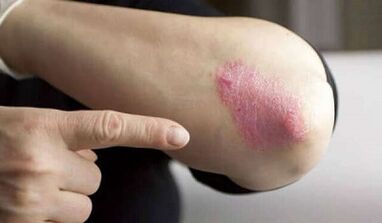
The main sign of the stationary stage is the cessation of the appearance of new spots and rashes.At the same time, the itching also weakens and becomes more tolerable.The rash loses its bright color, becomes discolored, and becomes invisible.This is also one of the signs of stabilization of the process.
The pink rims around the perimeter of the plaques disappear as the spread of inflammation stops.Active exfoliation and healing begins, regeneration of new healthy skin.
It is noticeable to the naked eye that peeling intensifies in the stationary stage.The scales completely cover the entire surface of the psoriatic spot, leaving no room for rims.
Psoriasis takes on a characteristic scaly appearance, by which ordinary people usually recognize it.Extensive peeling in the stationary stage is not dangerous.
When all the dead cells disappear from the surface of the psoriatic spot, healthy skin with a slight light tint will remain in their place.
Other signs of progression or stabilization
In addition to the appearance of the rash, spots and peeling, there are a number of other signs by which one can judge the development of the disease.This is the nature of the itching sensation (strong or tolerable), general condition, depressive mood.And also the presence of temperature.
In the initial stage, the itching is changeable, and the rash is incomprehensible.Further, the itching intensifies every day.In the acute stage of psoriasis, it becomes intolerable.Disturbs sleep, peace, and interferes with work.The person becomes irritable because the itchy sensation does not give him the opportunity to rest.
In the stationary stage, the itching subsides.Every day a person feels better.The general state of the psyche changes, negativity and depressive moods weaken.The duration of the stationary stage is several weeks - from 2 to 5.
Psoriasis in the attenuation stage
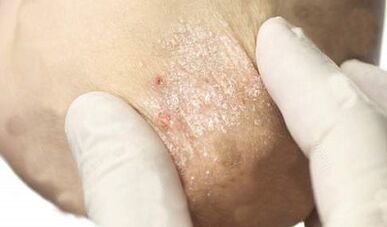
The attenuated stage of psoriasis is the almost complete disappearance of plaques, spots, redness, inflammation, and itching.
At this stage of the disease, only different pigmentation of the skin reminds of psoriasis.In place of former psoriatic spots, it looks lighter.The surface of healthy skin has a darker shade.
In some cases, so-called hyperpigmentation is formed.The skin at the site of psoriasis spots does not become lighter, but darker.In any case, differences in skin pigmentation will be visible for another one to two months.
Psoriasis after recovery: possibility of relapse
The possibility of relapse of psoriasis is determined by a person’s lifestyle, diet, allergic mood, and the condition of the body as a whole.It is also determined by the amount of toxins in his body, in the blood, and liver.You can reduce the likelihood of repeated skin inflammation if you strengthen your immune system and cleanse the body of toxins in the liver, blood vessels, and intestines.
Often after cleansing, seasonal relapses of psoriasis become rare.A person remains susceptible to the disease, but the likelihood of its occurrence is noticeably reduced.
Cleansing the body of toxins and taking vitamin-mineral complexes help boost immunity.This is especially important if immunosuppressants were used during treatment in the advanced stage of psoriasis.Their need was due to the work of inflammatory mediators.After suppression of autoimmune defense, it is necessary to restore immunity.